A battery alarm does not prove that the battery has failed: the fault may sit in the DC path, inverter settings, BMS communication, grid supply or a backup load. You will be able to separate those causes, decide between repair and replacement, and prepare the measurements a qualified technician needs for safe restoration.
Key takeaways
- Record the exact inverter alarm before resetting anything.
- Separate battery-side DC, inverter controls and AC or load faults.
- Test battery voltage, inverter limits and load behaviour independently.
- Replace failed parts only after confirming the original fault path.
Start with the alarm, isolators and a controlled test
Read the exact alarm code before resetting the hybrid inverter. Separate the event into three layers: battery-side DC, inverter/charger control, and AC, load, or grid. “Battery not charging” can result from low PV voltage, an open DC isolator, a charge-current limit, a BMS charge inhibit, or a degraded battery.
Do not replace the battery before checking those conditions.
- Confirm the battery breaker or DC isolator is fully ON, then inspect the fuse, cable lugs, polarity and visible corrosion without opening a live enclosure.
- Record battery voltage, current, state of charge, temperature, PV voltage and current, inverter mode, grid status, load power and BMS alarms from the same event time.
- Check configured chemistry, maximum charge current, absorption and float limits, low-voltage cutoff, restart voltage and temperature compensation against the battery manufacturer’s data. Never apply lead-acid temperature compensation to lithium batteries unless specified.
- Run a controlled test with a known load and observe whether the fault appears during charging, discharge, transfer to backup or high load. A reset can erase the symptom while leaving an overload, thermal derating or communication loss unexplained.
Before any hybrid solar plant for battery failure in coimbatore service, isolate AC, battery DC and PV DC, apply lockout/tagout, verify absence of voltage and wait the inverter’s specified discharge time. Daylight PV modules remain hazardous after the AC isolator is opened.
Do not bypass a fuse, short terminals or open a lithium enclosure; hybrid inverter battery problems require qualified testing. Check the enclosure for heat, restricted ventilation, direct sun, water ingress and misplaced temperature sensors.
Match the symptom to the battery chemistry
A lithium battery that stops charging or discharging abruptly points first to a BMS protection event; a lead-acid bank that delivers less backup over weeks points first to lost capacity, sulphation, heat damage, or a weak cell. Do not condemn either battery from an inverter alarm alone.
| Symptom | Lead-acid clue | Lithium battery or BMS clue |
|---|---|---|
| Low backup runtime | Resting voltage falls quickly, one cell reads low, terminals corrode, or the case swells. Repeated deep discharge and undercharging cause sulphation. | State of charge drops suddenly, cell-voltage spread increases, or the BMS limits discharge even while pack voltage looks normal. |
| Battery not charging | Low electrolyte where applicable, a weak cell, loose lug, or sulphation prevents voltage rising normally. | BMS charge inhibit, low or high cell temperature, communication loss, or a cell over-voltage alarm blocks charging. |
| Overcharging | Incorrect absorption or float voltage, unequal cells, or failed temperature sensing drives gassing and heat. | Excessive cell voltage triggers BMS cutoff; lead-acid temperature compensation must not be applied unless the lithium manufacturer requires it. |
| Inverter shutdown or changeover | Low battery voltage under load indicates insufficient capacity or a high-resistance connection. | An abrupt cutoff with a BMS alarm indicates protection, not necessarily failed cells. |
For hybrid solar battery troubleshooting in Coimbatore, inspect direct solar gain, ventilation, inverter heat transfer, and sensor placement. Review chemistry, charge limits, low-voltage cutoff, current limit, restart voltage, and temperature settings against the battery manual.
Record the event log with state of charge, temperature, current, and BMS alarms; never open a lithium enclosure or bypass its fuse. These checks separate chemistry faults from hybrid inverter battery problems.
Prove whether the battery, inverter or load is failing
A reset proves nothing. During hybrid solar battery troubleshooting in Coimbatore, reproduce the trip and time-stamp PV voltage/current, battery voltage/current, state of charge, temperature, inverter mode, grid status, load power and BMS alarms.
| Measurement | What it separates | Finding that points to the fault |
|---|---|---|
| Battery terminals versus inverter terminals under charge and load | Battery health from cable, lug or isolator faults | A large voltage difference, or a drop that increases with current, indicates resistance in a cable, fuse, lug or termination |
| Voltage across the closed battery fuse or breaker while current flows | Healthy protection device from a failing connection | Measurable voltage across it indicates a blown, high-resistance or undersized device; never bypass it |
| Battery voltage sag and recovery under a known load | Weak battery from a supply-path fault | Sharp sag at the battery terminals, followed by slow recovery, supports degraded cells; stable battery voltage with low inverter-terminal voltage indicates the path |
| Inverter DC input, charge/discharge current and programmed limits | Inverter control fault from battery failure | Correct battery voltage with zero commanded current points to charge limits, inverter hardware or a BMS charge inhibit |
| BMS alarm, state-of-charge, CAN or RS485 status and termination | Communication fault from electrical failure | Normal terminal voltage with stale SOC, missing data or a communication alarm points to the cable, address, termination or inverter interface |
| AC voltage, frequency and load power with the load removed and reapplied | Load or grid fault from battery-side trouble | The trip only under one appliance or excessive kW points to the load circuit, not the battery |
Record measurements before opening equipment. PV and battery DC remain hazardous; isolation, lockout and voltage verification belong to qualified personnel.
Choose repair or replacement without creating a second fault
Do not replace the battery until you have separated a battery-side DC fault from an inverter control fault and an AC, load or grid fault. A “battery not charging” alarm can result from low PV voltage, an open DC isolator, a charge-current limit or BMS charge inhibit.
Record event logs and time-correlated voltage, current, temperature, state of charge and load readings.
Before opening anything for hybrid solar plant repair in Coimbatore, control DC arc, short-circuit and backfeed risks. PV modules remain energised in daylight; an AC isolator does not isolate the PV side. Apply lockout/tagout, verify absence of voltage, and observe the inverter and battery maker’s discharge waiting time.
| Option | What it means | When it applies |
|---|---|---|
| Repair existing bank | Correct the external or serviceable fault | Bank capacity still meets required autonomy, and module voltages and temperatures remain matched during controlled charge and discharge |
| Replace one module | Change one approved, matched unit | One module diverges materially under load or charge, while the manufacturer approves its chemistry, age, capacity and BMS compatibility |
| Replace complete bank | Install a matched, correctly rated bank | Several modules fail, usable capacity misses autonomy, a thermal event damaged the bank, or the existing chemistry, BMS or protection is obsolete |
For hybrid solar plant for battery failure in Coimbatore, do not mix old and new batteries or different chemistries unless the manufacturer explicitly approves it. Orbit Solar India Pvt Ltd can use the measured autonomy requirement, inverter settings and fault-current rating to select a compatible replacement rather than relying on nameplate ampere-hours alone.
Related product
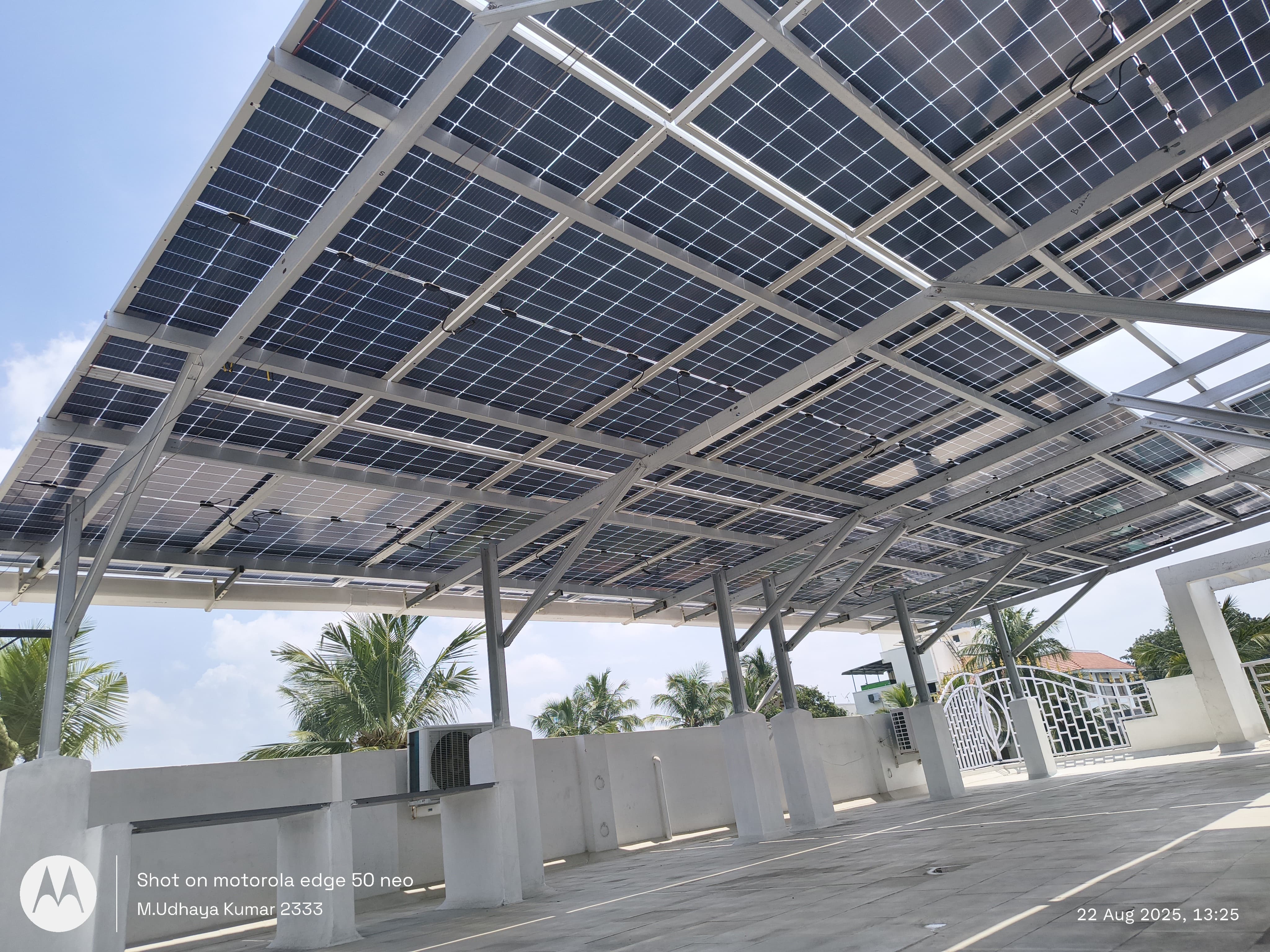 | Hybrid Solar Power Plant A hybrid solar power plant combines solar panels, battery storage, and grid connectivity to provide reliable, 24/7 electricity. View product → |
Maintain, recommission and document the system safely
Before hybrid solar plant repair in Coimbatore, isolate the PV DC, battery DC and AC sources, then apply lockout/tagout. Daylight can keep PV modules energised, and switching off the AC isolator does not make the DC side safe.
Verify absence of voltage, control backfeed, and wait the inverter and battery manufacturer’s specified discharge time before opening an enclosure.
A documented hybrid solar power system maintenance round should include:
- Torque-check DC and AC terminations, then use thermal inspection under load to find high-resistance joints that a visual check misses.
- Inspect cable glands, enclosure seals, corrosion, water entry, swollen batteries, ventilation paths, filters and direct solar gain.
- Review firmware, alarm and event logs, battery voltage, current, temperature, state of charge and cell trends.
- Test battery breakers, fuses, isolators, surge protection and other protective devices without bypassing them.
- Keep lithium battery enclosures closed to unqualified personnel; never short terminals, mix chemistries or use unauthorised equalisation on VRLA or lithium batteries.
After repair, confirm polarity, torque, fuse ratings, communications, temperature-sensor placement and charge or discharge limits. Start with no load, then run a known load while recording PV voltage and current, battery voltage and current, inverter mode, grid status, temperature and BMS alarms.
Verify charging, changeover, low-voltage protection and shutdown, then attach the readings, alarm code, replaced parts, firmware version and test date to the maintenance record. A reset without this evidence can hide a recurring overload, thermal derating or communication fault.
Frequently asked questions
What should you do first when a hybrid solar battery alarm appears?
Record the exact alarm code, check the event time, and inspect battery and inverter isolators before resetting the system.
Why does a hybrid inverter show “battery not charging”?
Low PV voltage, an open DC isolator, a charge-current limit, a BMS charge inhibit or degraded battery capacity can all produce this symptom.
How can you identify whether the battery or inverter is failing?
Separate battery-side DC, inverter and charger controls, and AC or load behaviour, then test each layer independently under controlled conditions.
When should you repair or replace a hybrid solar battery?
Confirm the fault path first; repair connections, settings or protection devices when those caused the event, and replace the battery when testing confirms cell, module or BMS failure.
Keywords